

SpaceX ‘pinky promises’ no bad impacts for Louisiana locals — then forced to backtrack
In a tense meeting, SpaceX managers told locals the massive spaceport won’t affect them at all. Then locals pressed for specifics.
In a tense meeting, SpaceX managers told locals the massive spaceport won’t affect them at all. Then locals pressed for specifics.

A federal program promises to pay for farmland preservation. Few landowners are taking advantage.

A support group and a lab in the St. Louis area provide resources for people with the allergy to mammal products — and evidence that its effects can be reversed.

In a tense meeting, SpaceX managers told locals the massive spaceport won’t affect them at all. Then locals pressed for specifics.

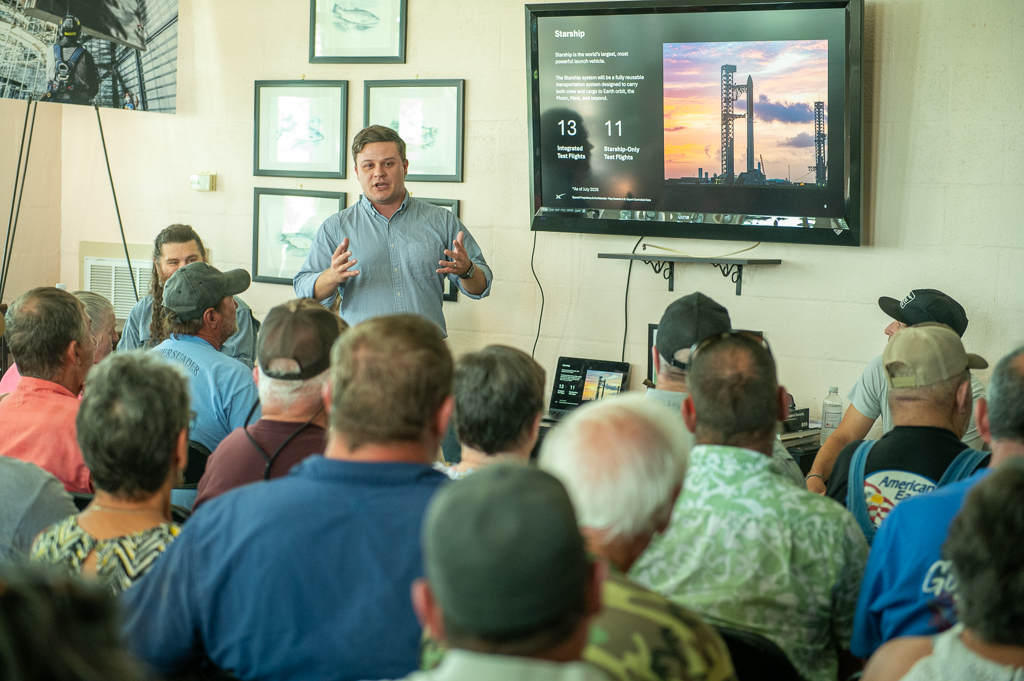
PECAN ISLAND, La. – At the front of a dimly lit cafeteria, half a dozen SpaceX high-level managers sat before a photo of a rocket.
Facing them sat the residents of Pecan Island — fishers and hunters, many of whom could trace their family’s presence here back generations.
Mark Soltys, principal launch engineer, began telling the crowd about SpaceX’s advances in aerospace technology: “Only SpaceX is demonstrating reusability,” Soltys said. With Starship, he said, “you’re actually increasing the performance, but also lowering the cost to send something to space by multiple orders of magnitude — yes, sir?”
Craig Pitre, a retired welder sitting in the front row, had raised his hand with a question.
“I don’t think too many of us are worried about the flagship rocket and recoverability,” Pitre told Soltys. “What we are all [worried about] is the ecological damage.” He continued, “All this stuff goes out and it’s going to pollute the waters. I mean, is there going to be any accountability for anything? That’s mostly what we are concerned about.”
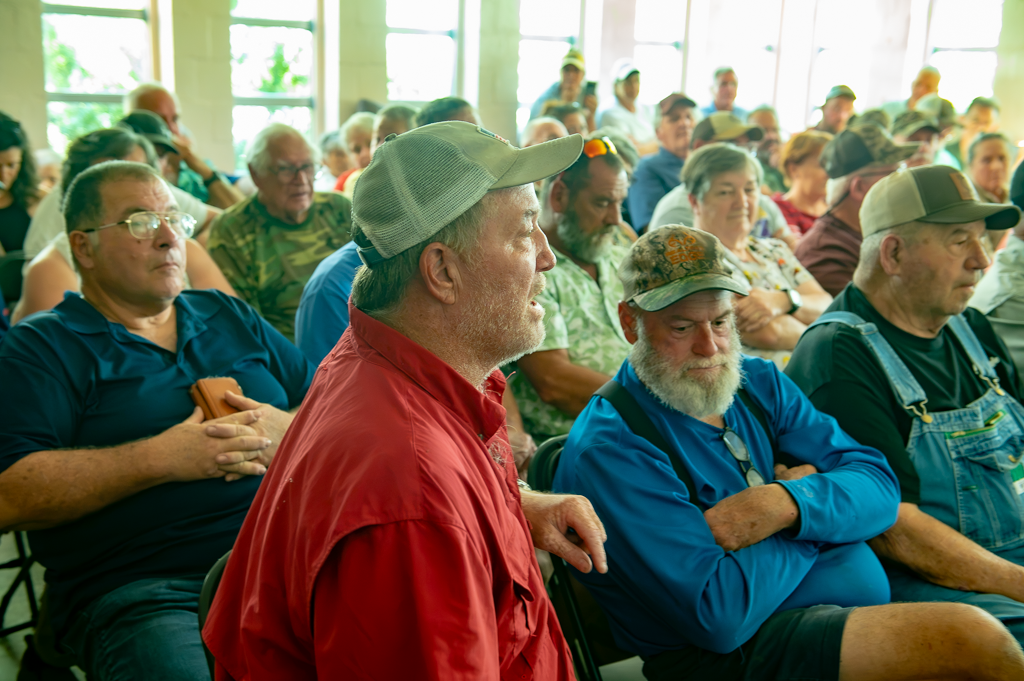
For the next two hours, residents peppered SpaceX representatives with questions about the incoming impacts of the company’s planned spaceport. Will they be able to stay in their homes? Will it kill off the wildlife? Will it worsen flooding and endanger their lives?
SpaceX reps repeatedly tried to reassure those present that the massive project would have no negative impact on their lives whatsoever. But they also were unable to answer many of the questions the residents posed. And in at least two instances, SpaceX reps were forced to backtrack, as locals held up the promises up against the sheer, unprecedented scale of the planned rocket launches.
SpaceX announced plans this summer to build a $100 billion spaceport here on the fragile coast of Vermilion Parish. The company is planning to ramp up to 10,000 annual launches of its superheavy Starship at the Louisiana site, or 30 launches a day. The 300 or so permanent residents of this village will be the closest locals — only about six miles from the planned launch pads.
The company’s goal, Soltys told the room, is “to make space life normal. You can go have lunch in orbit. You can go spend a weekend on the moon.”
Soltys didn’t mention that if those ambitions don’t pan out, the company can terminate its lease and agreement at any time for just $1,000, according to a copy of the PILOT lease agreement reviewed by The Lens.
Pecan Island residents were largely unmoved by the visions of lunch in orbit. After all: They live here, now, in Vermilion Parish, on Earth.
“You just explained the thrust and power,” Pitre pressed. “Well, there are consequences behind thrust and power.”
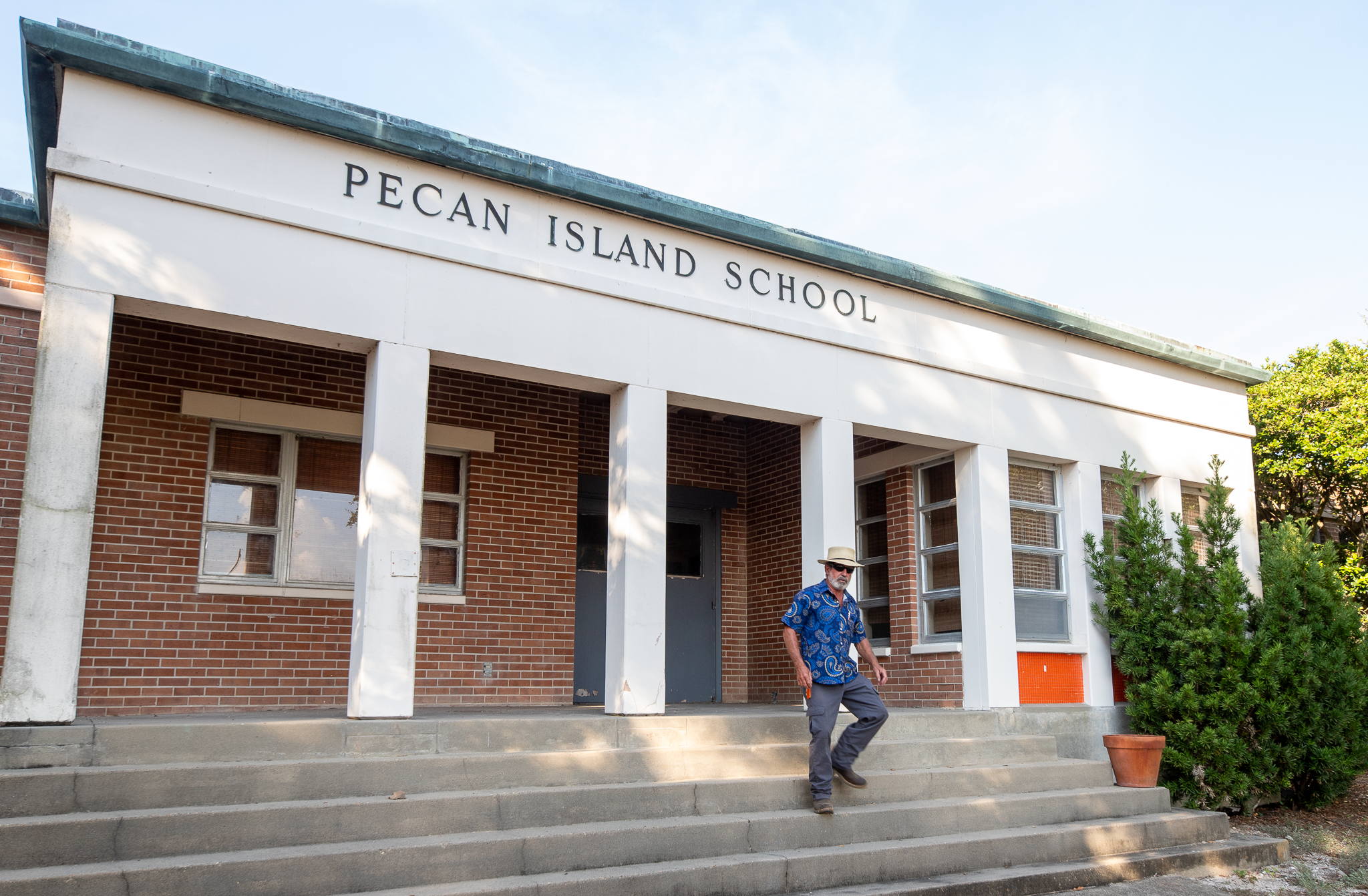
It is difficult to square the scale of SpaceX’s promises with the reality of Vermilion Parish today. Along the single two-lane road to the school, stands of cattle graze in the sun, and smoke billows up from sugarcane fields.
SpaceX had been tightlipped about the meeting. Residents were only alerted with a phone call a day or two before, and the late notice meant some couldn’t attend.
About 150 people crowded into the room, representing around half the village’s permanent residents. Before The Lens arrived, at least two Louisiana residents had been asked to leave by the Vermilion Parish Sheriff’s Office as they were not local to Pecan Island.
Early in the meeting, Katy Groom, SpaceX’s director of environmental regulatory affairs, told those gathered that “the actual launch infrastructure is very small.” SpaceX will be building across about one-third of their 125,000 acres — land leased from the local development board after the state acquired it from Exxon through a lawsuit. The company’s construction will still sprawl across 40,000 acres, nearly three times the size of Manhattan Island.
Soon after, questions started to arise.
“Am I still going to be able to get down there to my property?” asked “Lil Mark” Broussard, about an hour into the meeting.
“Yeah, we’re not going to deny access to property,” a SpaceX rep replied immediately.
But they were soon forced to retract that promise.
Broussard was referring to a strip of land between the shoreline and the southern border of SpaceX’s property. He runs horses and manages cattle on the land.
“We’re right in the middle. So am I still going to be able to go over there?”
Soltys repeated, “We are not going to deny you access to land.”
“I’m going to hold you to that.”
The launch sites’ exact location is not yet known, but in SpaceX renderings they are in a row along the coast, the Starships towering above the land where Broussard keeps cattle. How could SpaceX guarantee unrestricted access to property so close to the proposed launchpads? For a few minutes, the meeting dissolved into worried crosstalk.
Soltys then acknowledged, “It’s likely that there is a point where access is restricted — ”
“But do you know where that point would be?” a woman called out.
“No ma’am,” said Soltys, and soon steered the conversation elsewhere: “Without SpaceX, China is very much ahead of America” in the space race, he went on.
But another resident soon asked for specifics about access: “How big is the exclusion zone when you actually fly the rocket?” the man asked. Exclusion zones temporarily prohibit people or vehicles from access during launches.
Ben Lancaster, SpaceX’s senior manager for government affairs in Texas, said the zone would extend three to five miles from the launch site. That means the exclusion zone would reach from the launch pads, to the shoreline and then beyond, into Gulf waters.
“If you’re launching that many times a day, then ‘temporary’ means nothing,” the man pointed out. “So if you have property between the Gulf and the [launch] pad — you say you’re not going to block access, but if you can exclude, and you’re launching that many times, then access essentially is blocked. Correct?”
Soltys hesitated, then conceded: “Correct,” he said.
“Okay. Question answered. Access is blocked.”
Soltys’ admission suggests that the exclusion zone will extend into fishing waters, which many depend on for their livelihoods.
“Immediately off the coast here, within a quarter mile or so, is seasonally one of the best shrimping industries in the state, as well as crabs,” said a fisherman. SpaceX’s project is “going to severely affect some of the commercial fishing industry over here.”
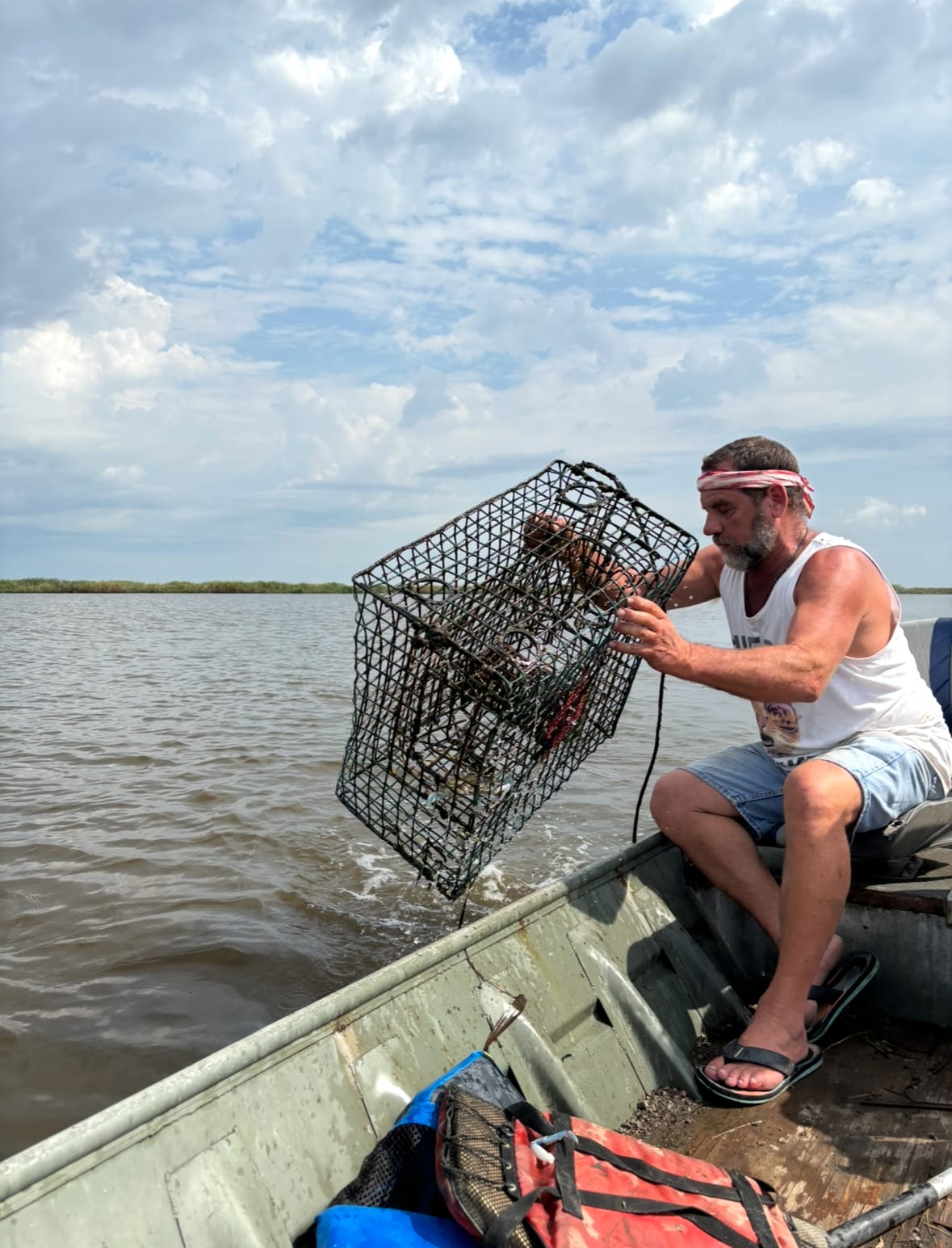
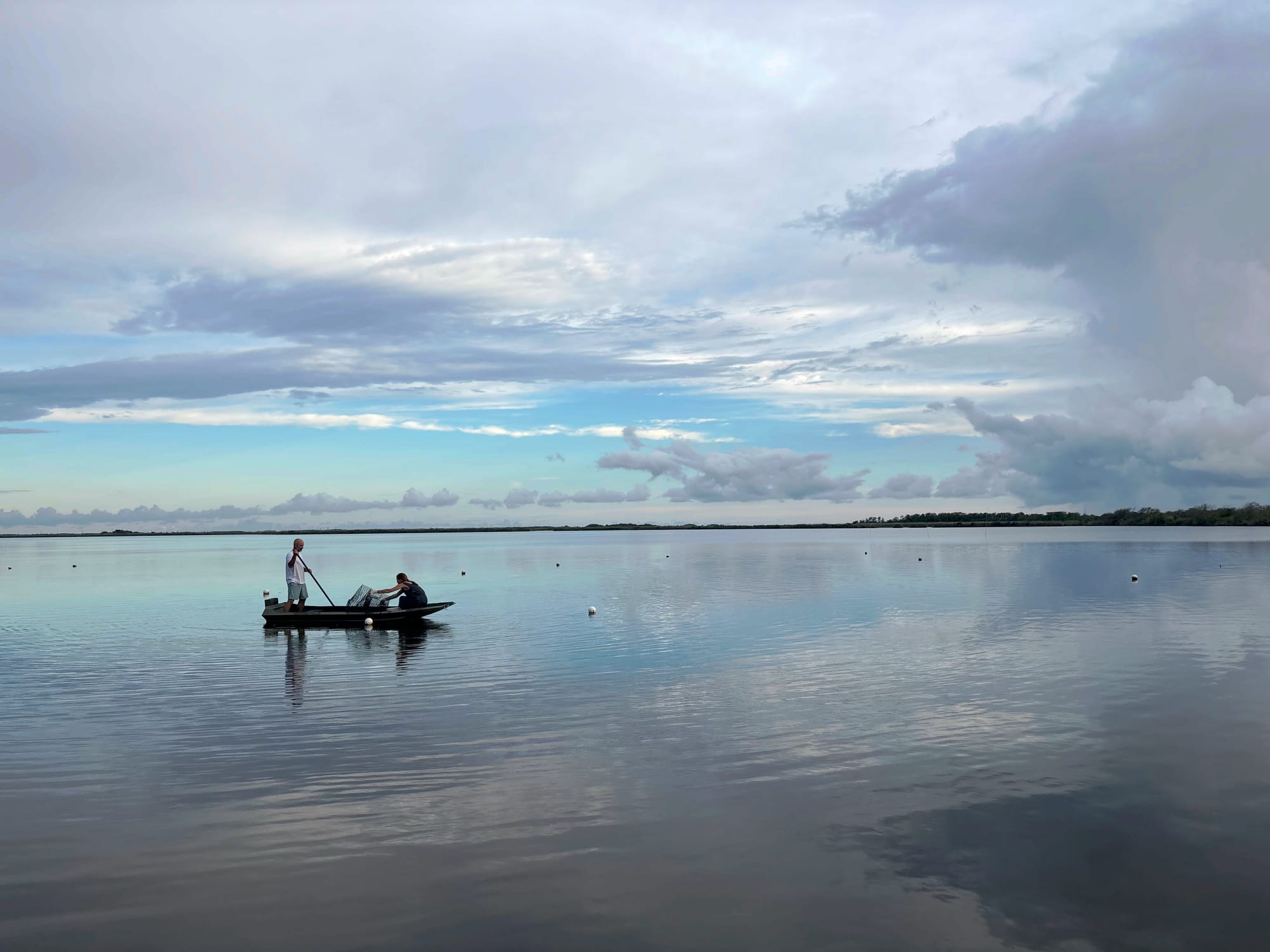
Left: Martin Broussard, raised on Pecan Island with his 13 siblings, pulls a crab trap out of the water. SpaceX’s exclusion zone, which temporarily prohibits people or vehicles from access during launches, would extend into fishing waters, which many residents depend on for their livelihoods. Right: Hollie Girouard crabs in a pirogue with a friend in the marsh waters south of Pecan Island. (Courtesy Brooke Broussard)
Soltys said that at their Texas and Florida launch sites, which are also home to large fishing communities, “there’s definitely kind of a mutual agreement that both industries need to coexist to be successful, and so the goal is to not impede.” He added that the “clear” zones during launches would grow smaller as their technology improves.
Vermilion Parish also sits at the base of the Mississippi River Flyway, a crucial migration route used by millions of shorebirds. After a 600-mile nonstop flight across the Gulf, this is the first land many of them see.
“What are y’all going to do about the Mississippi Flyway?” a resident asked a few minutes after Soltys’ about face on property access. “I’m not talking about planes, here, I’m talking about birds.”
“A big part of that we think is addressed through those required mitigations,” began Owen McDonough, SpaceX’s senior manager of government affairs. McDonough previously worked as an advisor for Chevron, and before that, was a director at the American Petroleum Institute.
“How you going to detour the birds?” the resident pressed.
Groom, SpaceX’s director of environmental regulatory affairs, began to explain that the buffer zone around the launch site — land that an outside biologist described as one of the best managed wetlands in Louisiana — will still be “a flourishing place for all the species.” She added, “The birds will momentarily flush, but they return.”
“How can they return in 30 [rocket] flights a day?”
Groom hesitated. “That is — that is one thing that we will have to figure out,” Groom conceded. “We don’t know what’s going to happen at 30 flights.”
Residents muttered in frustration. “BS, BS, BS,” said one man quietly.
“What happens if the birds don’t come back?” another asked.
Groom answered, “We’re going to go figure out where they are.”
Other questions revolved around water. An employee of Pecan Island Waterworks asked whether the massive spaceport would be using the same aquifer that supplies the village.
SpaceX didn’t have a clear answer for that either.
“Right now we are obviously very much in the design phase,” said Groom, though she added that SpaceX recycles most of the water it uses. Groom did not pledge to not use the aquifer, but said, “If we are, then we will figure out how it does not impact your guys’ source.”
Talk then turned to flooding. When SpaceX replaces wetlands with launch pads, marsh will no longer be there to dissipate the dangers of storm surge.
“Are y’all having any plans to make some levee system that would protect Pecan Island people?” a man asked. Or would flood protection only surround the company’s interests — thereby worsening flooding in their homes?
A barrier to protect SpaceX would “leave the far east and the far west exposed to the water going around what you’re building,” a woman chimed in. “So the ask would be to protect the entire island, and not just divert water into one side.”
McDonough, the senior manager of government affairs, later promised that SpaceX would not jeopardize the nearby lock system.
“No, I’m not talking about that,” a resident interrupted. “I’m talking about a hurricane coming in and going over locks. I mean, y’all are going to be protected with a 20-, 30-foot wall, but [the water] can go around, hit Rollover [Bayou] and come running down the road” to Pecan Island.
That’s what happened in 2005’s Hurricane Rita, when 12 feet of storm surge damaged most of the community’s structures. Will SpaceX surround themselves with a levee that endangers Pecan Island?
The SpaceX rep said they would be building “to those anticipated storm conditions.”
But the resident pressed again: “Are you building it for y’all? Or are you building it for us?”
“We don’t have that complete design figured out,” said Brandon Conroy, senior environmental regulatory engineer at SpaceX.
The following day, Conroy applied for a state permit, showing SpaceX’s plans to build a wharf and access road to start construction. These first steps alone would result in the loss of almost 400 acres of marsh, according to the application, which did not yet address flood protection plans.
Many were worried about how the noise and vibration from launches will damage their homes.
SpaceX candidly told the residents, yes, you’ll hear and feel the launches.
“It’s going to be loud,” acknowledged Groom. People inside their homes will feel a rumble, but they shouldn’t worry: “If somebody slams the door, your house does move, right?” she said. “So when that rumble happens from the rocket, it usually lasts like a minute, and you will hear it. And hopefully, it’s exciting to you.”
But some had already heard otherwise. About 80 people filed a federal lawsuit in April over alleged damage to their home caused by Starship launches in Texas. Reported damage includes cracked foundations, warped floors and burst water pipes. One plaintiff told Reuters that the foundation needs $100,000 worth of repairs.
SpaceX reps dismissed those concerns out of hand.
“We’ve seen no property damage whatsoever. There’s certainly lawsuits — you know, Mr. Musk has a big target on his back,” said Lancaster, referring to company founder Elon Musk. “Lots of people like to get headlines.”
Debris from launches in Texas has also been documented in marshes and wetlands. SpaceX described debris as “developmental growing pains” and pledged to pick it up.
Ultimately, none of the promises that SpaceX reps made in the room that afternoon were binding, as one local pointed out.
“If nothing’s going to happen to our homes, why did our governor put in place that we can’t sue SpaceX for damaging our homes?” a woman asked.
She was referring to recent legislation in Louisiana that means SpaceX cannot be held liable for “noise, sonic booms, overflight, vibration, light, heat, exhaust, smoke, odor, visual intrusion, temporary access restrictions, or any other disturbance.” SpaceX can only be held liable for injuries caused by falling debris if it “exceeds the normal risk” that goes with space flight.
Lancaster again dismissed concerns, saying that law was meant to stop “litigious trial attorneys who really want to make a buck.”
But Hollie Girouard, who lives part-time on a road between Pecan Island and the planned spaceport, soon asked again. “Why is there no protection written in for residents?” she said. “We’re going into this trusting people that we do not know, and [you’re] saying you’re going to pinky promise me.”
“What I can’t do is speak to anything on the legislation. I don’t have any control — I just can’t answer that,” said Groom. It was in fact SpaceX that pushed for the legislation as a condition of their arrival, per reporting by the Times-Picayune.
Groom told residents they could send SpaceX an email “if you feel that there is damage caused by the rockets.”
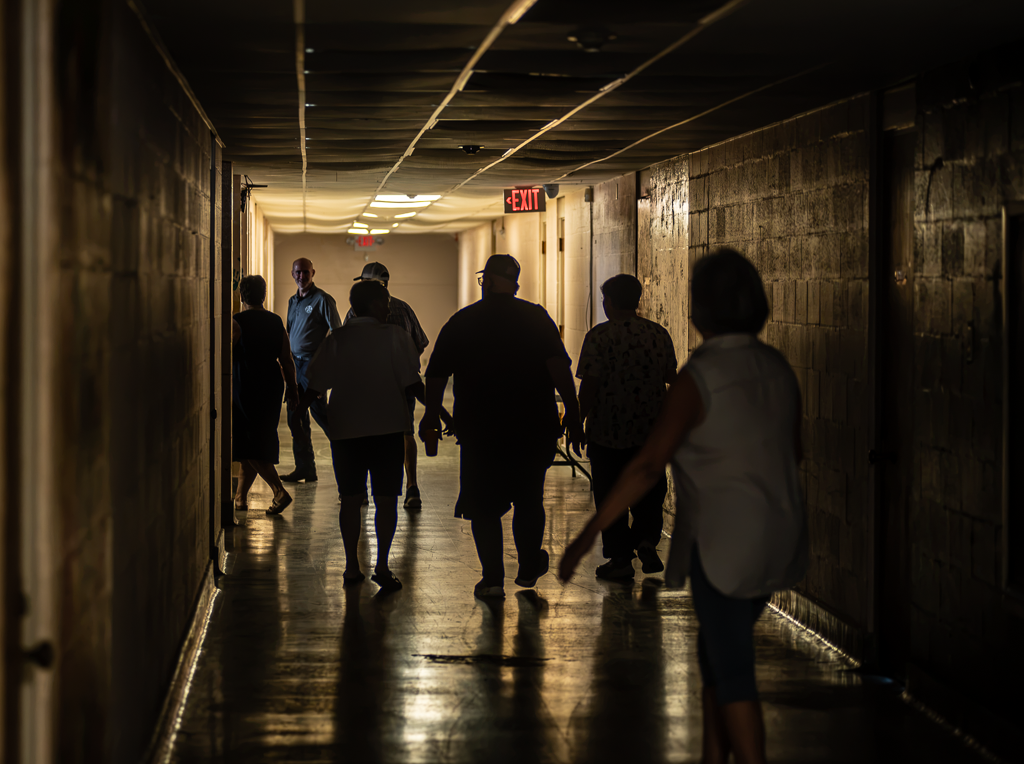
Girouard, like some others, left the meeting discouraged.
“I don’t think anyone was satisfied hearing that there would be an online complaint form instead of protections in the first place,” she told The Lens.
“I’m still in shock and I’m angry because of the way this deal was done,” said Brooke Broussard, a distant cousin of Lil Mark. She was especially frustrated by SpaceX’s insistence that the project wouldn’t harm wildlife. “They’re delusional. They know nothing about animals or nature. Or they do, and they’re just playing dumb,” she said. “It just all felt like such a farce.”
Broussard said members of her family “are in great despair.” The wetlands here are already damaged by the oil and gas industry.
“Can we learn from our mistakes, and maybe not pump concrete into that so-sensitive marsh that is absolutely teeming with life?” she said, her voice breaking. “Teeming with life.”


A support group and a lab in the St. Louis area provide resources for people with the allergy to mammal products — and evidence that its effects can be reversed.

The Mississippi Alluvial Valley was once the ‘breadbasket’ of black bears


The Great River Road, an artery running from Minnesota to Louisiana, is providing a lifeline to small towns


Amid dangerous heat, resources for those without air conditioning vary at the local level
Environment and agriculture news from across the Mississippi River Basin — delivered straight to your inbox.