

Researchers, patients optimistic in fight against alpha-gal syndrome
A support group and a lab in the St. Louis area provide resources for people with the allergy to mammal products — and evidence that its effects can be reversed.
A support group and a lab in the St. Louis area provide resources for people with the allergy to mammal products — and evidence that its effects can be reversed.

The Gulf’s Flower Garden Banks has been viewed as healthy, but a new study shows signs of damage.

More than three-quarters of member cities in a Mississippi River coalition have been approached to host AI infrastructure.

A support group and a lab in the St. Louis area provide resources for people with the allergy to mammal products — and evidence that its effects can be reversed.

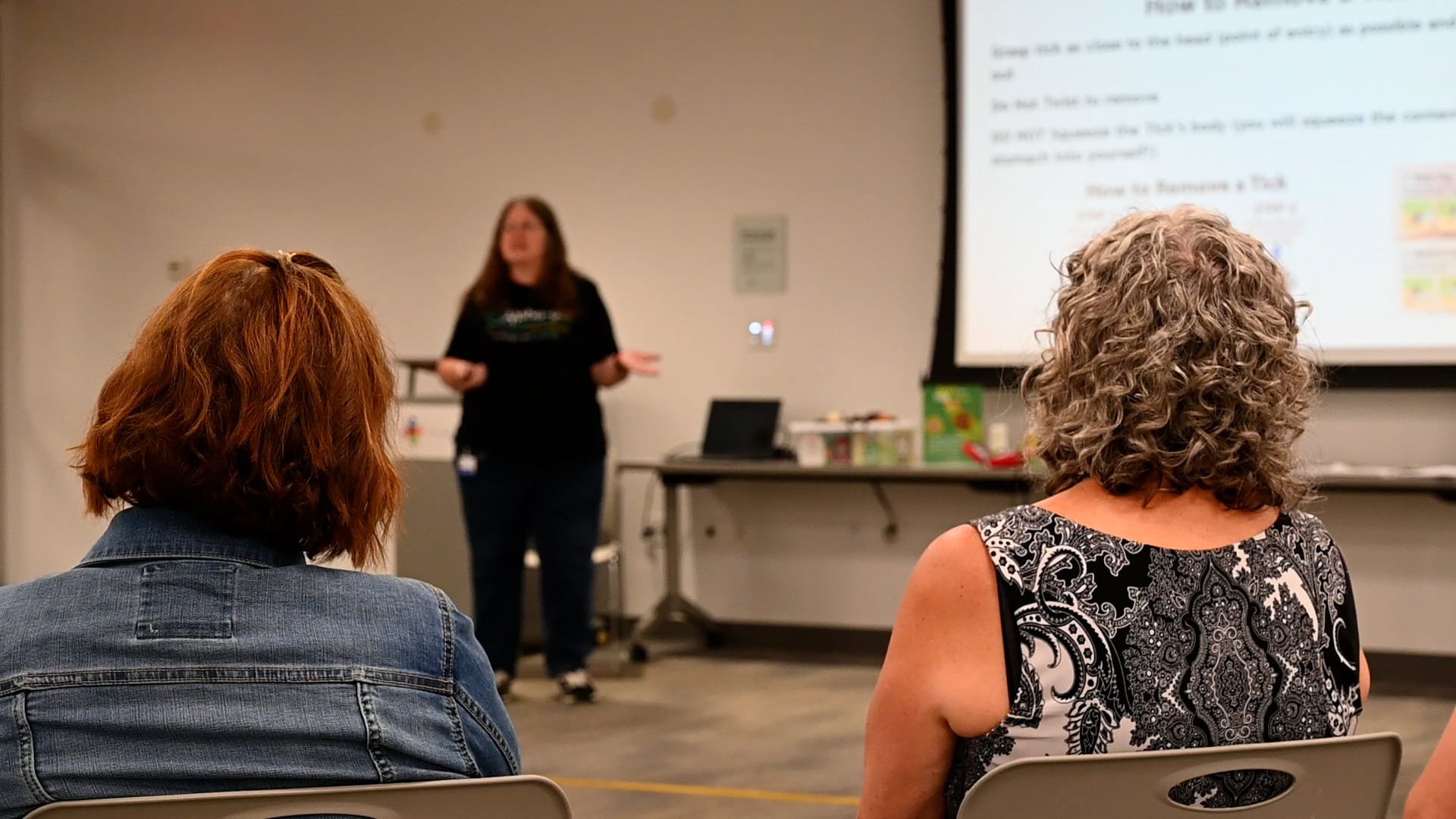
Down a flight of stairs in Ellisville, Missouri, through a row of children's books, people trickle into a bare multipurpose room. On a table, lay brochures, plushies and paperbacks, each featuring the same antagonist, the lone star tick.
The lone star tick is the most common carrier of an increasingly common illness called alpha-gal syndrome. Mary Lynn Cady contracted alpha-gal in 2011. Now, she runs a support group at the Daniel Boone Branch of St. Louis County Library for others affected. On the first Wednesday of every month, they discuss their unique challenges in navigating this new allergy.
“I didn't know anybody else who had alpha-gal and you didn't hear about it anywhere,” Cady said. “You couldn't Google it or go to the CDC (Centers for Disease Control and Prevention) and get information.”
Alpha-gal syndrome is an allergy to red meat, dairy and other products that come from mammals. Many people contract it as adults, making them learn about vulnerabilities and EpiPens later in life, concepts that didn’t have significance in their daily lives until recently.
Food, cosmetics and medication can all cause allergic reactions. Some even report sensitivity to fumes. Symptoms typically appear two to six hours after exposure.
“You feel alone when you first get diagnosed,” Cady said. “You can't really eat without thinking about what you're eating. You always have to be careful.”
Cady started a yearly program tackling tick prevention in 2018. As awareness around the condition grew, so did the number of attendees with the allergy. Community members approached Cady and expressed a desire for something more permanent. The Living with Alpha-Gal support group was born in the fall of 2025 with attendees from all over Greater St. Louis.
With unique challenges compared to other acquired allergies, those who contract it are often stuck navigating a condition that scientists are still trying to understand.
“The first year, I think probably with almost any diagnosis, is a learning curve,” Cady said. “There's just a lot of trial and error.”
The cause is a sugar, officially called galactose-α-1,3-galactose but commonly shortened to just “alpha-gal,” that doesn’t present in the human body naturally but is found in most mammals like cows and other livestock. It enters the body when a tick, typically the lone star tick, bites a person and transmits alpha-gal into an individual's blood. Once infected, their immune systems can potentially develop a new allergic reaction when exposed to anything containing the alpha-gal sugar.
Cases have grown, but it’s unclear exactly how many are in Missouri. The state does not yet track cases, and businesses are not legally required to report alpha-gal in their products. The Center for Disease Control estimates about 450,000 cases to date.
“It's often patients who are going into their doctor saying, ‘I think I have this condition. Can you test me for it?’ The word has gotten out more successfully to the general public even than to health care providers,” said Dr. Maya Jerath, an allergist and immunologist at Washington University in St. Louis.
Jerath, along with her colleague Dr. Peggy Kendall, is looking for a more accurate way to diagnose and treat the allergy.
 Elizabeth L. Cline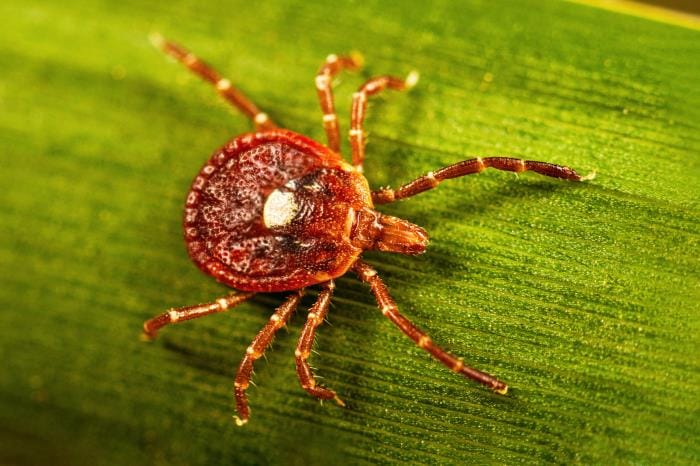
Many patients naturally see less sensitivity over time. This can be measured in patients’ blood. For patients whose alpha-gal antibody levels had started to decline, researchers at Washington University developed a nine-day protocol to safely reintroduce meat. In a recent study, 100% of eligible patients were able to clear the allergy.
“What we've done so far has shown that it will wane naturally. That's where your body will clear it itself and you can go back to eating meat. But we actually have some interventions that we would like to study to see if we could actually do something to patients that will make it go away,” Jerath said.
Scientists must first learn what causes the allergic reaction to develop before they can treat it. The antibody was found in 24% of the population in the five states where it's most common — Arkansas, Kentucky, Tennessee, Virginia and Missouri — but the majority do not have the allergy. When comparing symptomatic and asymptomatic blood, they found a unique set of cells that might be the difference.
“What we're finding is a small population of cells in patients with alpha-gal that is not present in patients without alpha-gal or is present at lower levels,” Kendall said.
Researchers don’t yet know if this clump of cells is the cause of the disease or simply a marker. If it’s the cause, then doctors have found what they need to target for potential treatments.
Alpha-gal syndrome can affect anyone, but for those with outdoor lifestyles or who live in rural areas, it’s not as easy to avoid.
“It's hard to confine yourself to your house. Many patients say, ‘I just stepped in my driveway. I didn't even go anywhere.’ So it's really hard to adapt your lifestyle if that's where you're living,” Jerath said.
Alpha-gal syndrome is a growing concern for hikers, ranchers, hunters and even those whose houses are slightly off the beaten path. When their entire lifestyle is at risk, fear and anxiety can follow.
Cady is optimistic and excited with where research and awareness are heading but still takes every precaution. She covers up in long pants, long sleeves and sprays everything with insect repellent to simply manage yardwork. Being cautious can be a lot of work.
“I live in the woods, so mowing my lawn is probably the most time I spend outside anymore,” Cady said. “It doesn't mean people should be afraid of the outside, but I guess I kind of am a little bit.”
Living with alpha-gal can be a serious adjustment, but as cases rise, so does awareness, resources, and data.
The state of Missouri is in the process of requiring labs to report positive alpha-gal tests, more citizens and healthcare professionals are learning about the allergy, and researchers like Jerath and Kendall are looking forward to the future.
“I think it is nice to know that this is not necessarily a lifelong allergy,” Jerath said. “We're in the infancy of fully understanding it.”
Funding provided by Bayer, Report for America, Missouri Foundation for Health, Connie and Dan Burkhardt, Betsy & Thomas Patterson Foundation, and a generous gift made in memory of Mr. and Mrs. Theodore P.


The Mississippi Alluvial Valley was once the ‘breadbasket’ of black bears


The Great River Road, an artery running from Minnesota to Louisiana, is providing a lifeline to small towns


Amid dangerous heat, resources for those without air conditioning vary at the local level

For 150 years, silos have been a fixture of the Corn Belt, but efforts to preserve them have been haphazard.

Environment and agriculture news from across the Mississippi River Basin — delivered straight to your inbox.