

Researchers, patients optimistic in fight against alpha-gal syndrome
A support group and a lab in the St. Louis area provide resources for people with the allergy to mammal products — and evidence that its effects can be reversed.
A support group and a lab in the St. Louis area provide resources for people with the allergy to mammal products — and evidence that its effects can be reversed.

The Gulf’s Flower Garden Banks has been viewed as healthy, but a new study shows signs of damage.

More than three-quarters of member cities in a Mississippi River coalition have been approached to host AI infrastructure.


Less than a month into the official start of summer, record-breaking heat has already swamped Louisiana and much of the South. Forecasters say the dangerous heat will likely continue.
The federal Climate Prediction Center forecasts above-normal temperatures for at least the next two weeks. Even through September, the average temperature is expected to be higher than normal across the south from Texas to Florida.
“It does not mean that every single day will be above normal, but it means on average over the course of the next few months above normal seems like the more likely forecast on any given day,” said Ben Schott, a meteorologist with the National Weather Service’s Slidell, Louisiana, office.
According to Climate Central, a nonpartisan science nonprofit, the South, Southeast, Northwest, and Southwest have experienced the greatest increase in high heat index days in the past 50 years.
Above-normal temperatures don’t necessarily translate to long stints of extreme heat, but a persistent dome of heat sitting over the South has already triggered the highest number of excessive heat warnings in any given year.
By the end of June, New Orleans had already experienced a record number of excessive heat warnings after a lengthy stretch with heat indices above 110 degrees and nightly temperatures steadily sitting above 80 degrees. In 2022, the Slidell office issued five of such warnings.
In Texas, at least 13 people have died from heat-related illness this year from the ongoing heatwave, according to the Associated Press. Farther west, Phoenix has seen temperatures linger at 110 degrees or higher for 13 days straight, with the potential to soon break the record of 19 days as forecasts offer little hope of relief.
Heat is an invisible force created by a mix of ingredients in the earth’s atmosphere. Currently, a massive high pressure bubble is hovering over the Gulf South region, driving temperatures up.
“When you have high pressure over the top of you, the air sinks, and when that happens, it compresses the atmosphere,” Schott said. “The physical effect of that is actually warming the air.”
As the atmosphere is squashed down, the high pressure traps the heat. Unable to escape, the heat can get stuck recirculating in the area as the sun continues to beat down.
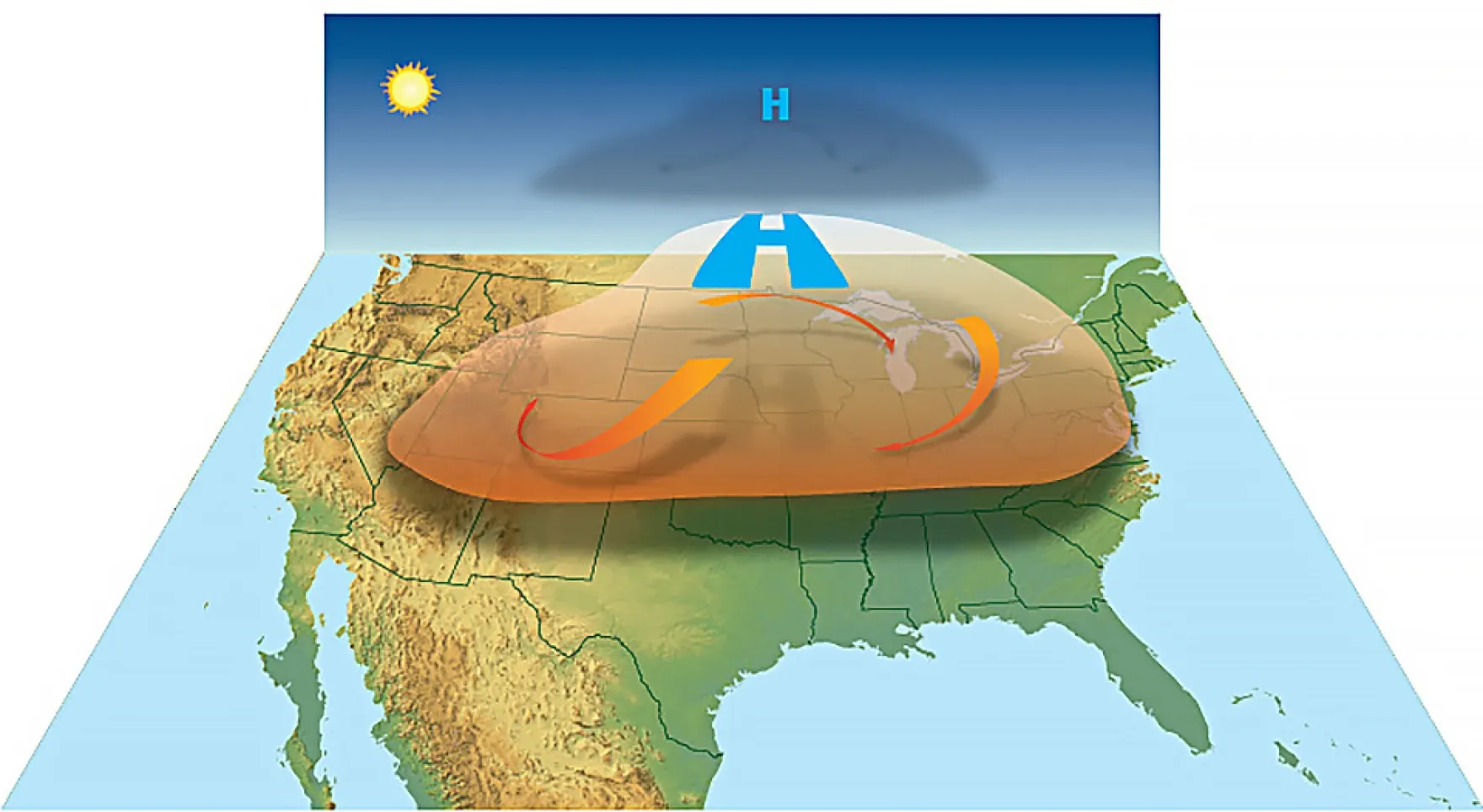
This effect is compounded by the lack of rain. Schott said dry earth heats up even faster and radiates it outward. Though Louisiana hasn’t experienced the intense drought of the Midwest, the state is abnormally dry this summer, according to the U.S. Drought Monitor.
Combine these factors with a steady stream of humid air from the Gulf of Mexico, and you have the potentially fatal weather that Louisianans are facing today, said Schott.
The National Weather Service issues excessive heat warnings when the heat index – what the air feels like due to actual temperature and dew point – will exceed 113 degrees during the day. Schott said the agency will also issue warnings if the heat index is high and temperatures don’t drop below 80 degrees at night.
Under the conditions of high temps during the day and the lack of cooling down at night, it’s difficult for your body to get any relief from the heat, posing a health threat as the body can start to break down after long-term heat exposure.
“The cumulative effect on the body is very detrimental,” Schott said.
Across the state, 2,700 people go to the emergency room for heat-related illnesses each year, according to a new report from the Louisiana Department of Health.
Living or working outside in the heat can compromise your body’s ability to regulate its own temperature. When that happens, it can result in heat exhaustion, heat stroke and even death. Researchers have also found links to high temperatures and an increase in mental health issues.
While heat can affect everyone, children and elderly people are especially vulnerable.
“They’re not able to control their body as well” as a healthy, young adult, Schott said.
He added that income disparities can also leave people more exposed to heat if they have limited access to air conditioning, especially as nights grow hotter along with days.
Climate Central recently found that nighttime temperatures are warming nearly twice as fast as summer daytime highs.
As human-fueled climate change continues and global temperatures rise, the South can expect amplified extreme weather, from heatwaves to drought to hurricanes.
According to Climate Central’s Climate Shift Index, climate change has made the recent weather in south Louisiana five times more likely to occur. The model looks at daily weather across the country and analyzes how much more common a weather pattern, like precipitation or temperature, is in an altered climate compared to a world without global warming.
One of the best ways to protect yourself from heat is to limit your time outdoors and stay in air- conditioned rooms with the windows closed.
On the community-scale, the Centers for Disease Control and Prevention has also advised cities to use early heat wave warnings — like those issued by the National Weather Service — as a trigger for preventative actions like opening “cooling centers,” or publicly-accessible air-conditioned spaces.
“Air-conditioning is the number-one protective factor against extreme heat, which is an essential health resource for vulnerable populations,” according to the CDC.
Access to drinking fountains or swimming pools can also help people stay cool.
This story is a product of the Mississippi River Basin Ag & Water Desk, an independent reporting network based at the University of Missouri in partnership with Report for America, funded by the Walton Family Foundation. Sign up to republish stories like this one for free.


Diagnoses of the severe, tick-borne allergy are rising throughout the basin. The frontlines of the disease offer lessons.


Solar panel misinformation, spread by bots and by neighbors, derailed a project in Cajun Country that promised millions in local tax revenue. The same methods are being employed nationwide.


Coastal scientists says change is inevitable, but hope is not lost

040126_HAA_Earlier_Spring_CC0:00/81× COLUMBIA, Mo. — As a row crop farmer in St. Joseph, Mo., Joe Lau
Environment and agriculture news from across the Mississippi River Basin — delivered straight to your inbox.
